Corporate training often fails to change behaviour because it delivers awareness, not application. A single session gives people insight and intent, but it rarely gives them repeated practice, manager support, reinforcement at work or a team and culture that reward the new behaviour. As FocusU puts it, training is not transformation, and completion is not capability. Behaviour changes when learning is designed as a journey with transfer and measurement built in, not as a one-off event. If you’ve ever watched a team leave a workshop energised and return to old habits within weeks, you’ve seen this gap first-hand. This guide explains why it happens, the seven most common causes, and what to do about each one. Key takeaways Awareness is not behaviour. Knowing what to do and doing it consistently are different things. One exposure is not proficiency. Real change needs spaced practice, feedback and repetition. Managers decide whether learning survives. If reporting managers aren’t aligned to what was taught, learning is doomed. Individuals sit inside a system. Teams, leaders and culture pull behaviour back unless they change too. Satisfaction scores don’t prove change. Measurement has to look at what people do afterwards. Training isn’t always the answer. Sometimes the real blocker is a system, a process or leadership belief. Training vs transformation at a glance What happens after a typical workshop? FocusU describes a familiar four-step pattern: Session: high energy, aha moments and good feedback scores Intent: action plans and pledges are written Reality: inbox, targets, old habits and friction take over Result: little visible behaviour change The workshop did its job of creating insight and intent. What was missing was everything after it. FocusU’s own view, shared on its Why FocusU page, is that most learning creates awareness, but awareness alone doesn’t change behaviour, and without behaviour change, business outcomes don’t move. Why doesn’t corporate training change behaviour? Seven causes 1. Awareness is mistaken for behaviour Most programmes are designed to inform: frameworks, models, tips. But behaviour is a habit, and habits don’t change because someone understood a concept once. What helps: designing for realisation, not information. FocusU’s FACETS design filter asks whether learners are “arriving at a realization” or just being stuffed with knowledge, and whether they get a chance to apply learning inside the session. See the learning design process and the blog on the anatomy of impactful learning experiences. 2. One explanation never creates proficiency Expecting someone to master a skill after a single exposure is unrealistic. FocusU’s position is that one explanation doesn’t create proficiency, so it designs for spaced practice, peer learning, application within the room and structured opportunities to try, fail and try again. What helps: treating learning as a journey. Read why in Why One-Day Training Doesn’t Work: The Case for Learning Journeys That Drive Real Change, and explore learning journeys and microlearning for reinforcement over time. 3. There is no plan for learning transfer If what is learnt isn’t applied, the entire intervention, in FocusU’s words, becomes a tick-mark exercise. Many programmes end at delivery, with no one responsible for what happens on Monday morning. What helps: planning transfer from the start. FocusU’s process includes a dedicated Learning Transfer phase that asks how learning continues beyond delivery and how the process is monitored, supported and managed. For the practical side, read Why Training Alone Isn’t Enough: The Power of Reinforcement in Workplace Learning. 4. Managers aren’t aligned to what was taught A learner returns to a manager who has different expectations, different language and no idea what the workshop covered. FocusU’s principle is blunt: if reporting managers are not aligned to what was taught, learning is doomed. What helps: involving managers before, during and after the programme. Explore manager capability development to build the leaders who reinforce new behaviours. 5. The system around the learner hasn’t changed A more self-aware leader in an unchanged team dynamic simply becomes more aware of the dysfunction. Behaviour sits inside teams, leadership and culture, and those layers pull people back to the default. This is the thinking behind the FocusU Behaviour Stack, which holds that behaviour change happens across four nested layers (Individual, Team, Leaders and Culture) and sticks only when they align: 6. Success is measured by satisfaction, not change Most L&D measurement stops at “did learners enjoy it?” That tells you about the session, not about the shift. A programme can score highly and change nothing. What helps: measurement designed in from the start. FocusU follows Will Thalheimer’s LTEM framework, a more honest way to see whether learning moved the needle. Read its point of view in Designing Learning with LTEM. 7. Training was the wrong answer to begin with Not every performance problem is a learning problem. FocusU’s design philosophy includes “qualify what can move the needle”: one size never fits all, and training is not always the answer. Sometimes the real blocker is unclear priorities, a broken process or sponsors who aren’t bought in. What helps: a diagnosis before any design. Begin with why, link the intervention to a business outcome and be honest about what training can and can’t fix. What does training that changes behaviour look like? A programme with a real chance of changing behaviour tends to have these features: A named business outcome the learning is meant to move Specific, observable behaviours agreed before design begins Experiential design where people practise, not just listen Spaced reinforcement after the session Manager and leader involvement, not individuals alone A transfer plan that someone owns Measurement of workplace application, not only feedback scores Accountability for the result FocusU’s learning design process is built around these ideas. It moves every engagement through four phases: Preparation, Learning Delivery, Learning Transfer and Measuring Impact, with the FACETS filter (Feedback, Application, Contextual, Experiential, Tailored, Stimulating) applied to every programme. How does FocusU turn the gap between training and transformation? FocusU’s approach can be summed up as moving people “from knowing to doing”: Understand what needs to change. Start from the business outcome
Who Does FocusU Work With? Industries, Company Sizes and Use Cases
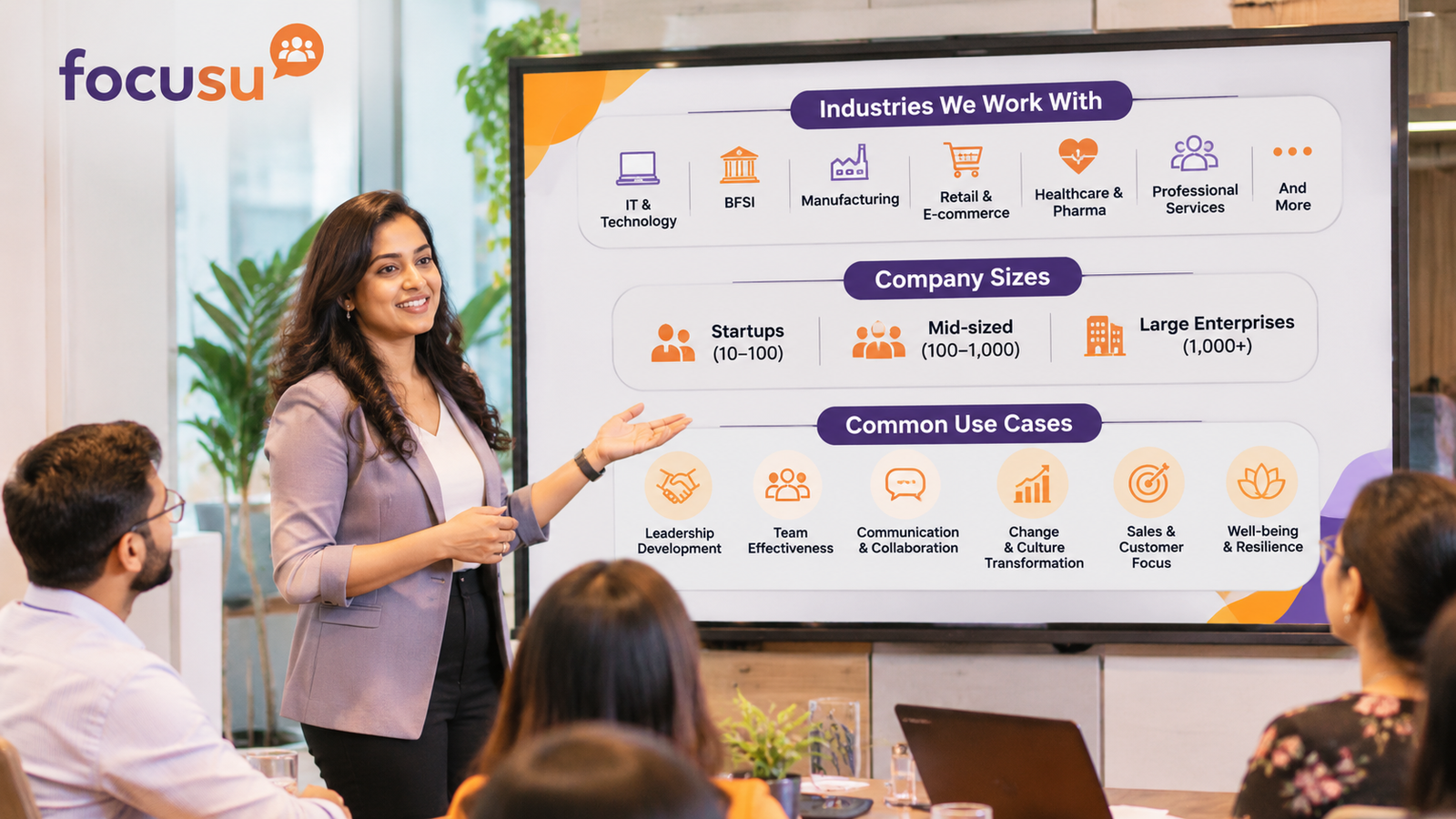
FocusU works with organisations across more than a dozen industries, including BFSI, IT and ITES, FMCG, pharmaceuticals, manufacturing, consulting, energy, healthcare and hospitality, and its client list runs from local Mauritian firms to global enterprises. Typical engagements include leadership and new-manager development, team effectiveness, onboarding and induction, values and culture programmes, and gamified learning, delivered in India, Mauritius and beyond. FocusU has served 1000+ organisations and reached 40k+ learners in 2025. If you’re wondering whether a corporate learning partner has worked with companies like yours, this guide lays out who FocusU serves, the industries it has worked in, the kinds of problems it is brought in to solve, and how to check fit for your own organisation. Key takeaways Industries: 16 sector groups appear on FocusU’s Mauritius sectoral expertise page, from Auto and Chemicals to BFSI, Healthcare and Real Estate and Hospitality. Geography: clients across India and Mauritius, with work for organisations beyond these markets. Scale of work: from a 64-person induction workshop to an onboarding journey for 11,000+ new joiners. Typical needs: leaders, new managers, teams, onboarding, culture and ways of working. Track record: 15+ years, 1000+ organisations, an average CSAT of 9.2, and the “Happy or Free” guarantee. FocusU’s clients at a glance Which industries does FocusU work in? FocusU’s sectoral expertise page lists the sectors where it has customised learning journeys and engagement experiences. The sector groups include: Auto and Ancillaries Chemicals Consulting Pharmaceuticals FMCG Fashion and Apparel Energy BFSI Healthcare IT and ITES Manufacturing Ecommerce Government, Education and Non-profit Consumer Goods, Retail and Trading Media and Publishing Real Estate and Hospitality The India version of this page is on the main Sectoral Expertise page, and the Mauritius work is shown in the Mauritius case studies and Mauritius testimonials. What has FocusU done in each industry? These are examples from FocusU’s own sectoral expertise page: Which companies has FocusU worked with? FocusU’s homepage shows it is trusted by 1000+ organisations across India and beyond. Client logos and testimonials include Lam Research, Reckitt, CGI, Balmer Lawrie, Syngene, Carrier, HSBC, Kohler, emids, Dell and PwC, along with testimonials from HR and learning leaders at Lenovo, Novo Nordisk and HSBC. In Mauritius, clients include Accenture, Absa, Hilton, Aspen Global and Harel Mallac, among many others. You can read what clients say on the testimonials page and see measurable results in Our Impact. What company sizes does FocusU work with? FocusU doesn’t publish a minimum or maximum company size, and describes its work as spanning organisations of all sizes. The evidence in its client work shows a wide range: Smaller and specialist firms: boutique consulting, legal and finance firms in Mauritius, where engagements such as an induction workshop for 64 participants or a team-building workshop suit a compact team. Mid-sized organisations: programmes such as multi-part learning journeys, coaching and offsites for regional businesses. Large enterprises: long-running programmes such as a 12-month leadership journey at Surya Nepal, a 2-year journey with Hindustan Unilever’s North regional leadership team, and a gamified onboarding programme covering 11,000+ new joiners at a Big Four firm. The practical test isn’t headcount. It is whether you can name a business outcome and the behaviours that would move it. FocusU’s learning design process starts there, and it adapts the format and scale to fit. What problems do organisations bring to FocusU? Across industries, the use cases fall into a handful of repeating needs. They map to FocusU’s four solution areas: Better Leaders, Better Teams, Better Culture and Better Work. 1. Developing leaders and new managers For organisations that need leaders who sustain performance, or managers who move from task execution to ownership. See manager capability development. A 4-month blended programme with Providence used micro-actions and feedback loops to help first-time managers make confident decisions. A 12-month journey helped senior leaders at Surya Nepal shift to future-ready decision-making during a major category transition. 2. Aligning and strengthening teams For teams that need trust, alignment and better collaboration, whether they are new, remote or high-stakes. See interpersonal effectiveness and team bonding workshops. A 2-year journey built shared ownership and execution discipline across Hindustan Unilever’s North regional leadership team. FocusU’s award-recognised work includes enhancing trust and collaboration at CGI and strengthening teamwork among new recruits. 3. Onboarding and induction For organisations that want new joiners aligned with values, strategy and ways of working from day one, often to reduce early attrition. A gamified onboarding journey for a Big Four firm reduced early drop-off across 11,000+ new joiners. Another gamified programme was recognised for onboarding in the global healthcare industry. Induction programmes in Mauritius include work for MUA, Harel Mallac Technologies and Siebel (see the sectoral expertise page). 4. Shaping culture and values For organisations that want rituals, language and structures that reinforce the right behaviours. See culture and organisational development. Values cascading programmes for BDO IT Consulting and Kalexius. A recognised culture cascade programme, which won a Gold HCM Learning badge in 2025. 5. Turning intent into consistent execution For organisations that want ways of working that turn plans into delivery. See Better Work, including simulations and the Lego Serious Play flagship offering. 6. Engagement, wellness and team experiences For teams that want connection, energy and wellbeing, such as wellness workshops, virtual team engagement sessions and experiential offsites, as shown in the Petredec, Redwood Finance and Quantico work above. Which FocusU formats suit which type of organisation? Is FocusU a good fit for your organisation? FocusU is likely a strong fit if you: Want training to produce visible behaviour change, not just good feedback scores Can describe a business outcome and the behaviours that would move it Are going through a transition, such as new managers, rapid hiring, a market shift or a culture change Need a partner that can customise across industries, formats and team sizes Value outcome accountability, as reflected in the Happy or Free guarantee: if you don’t see the shift agreed on, FocusU makes it right or you don’t pay It may be less suited if you