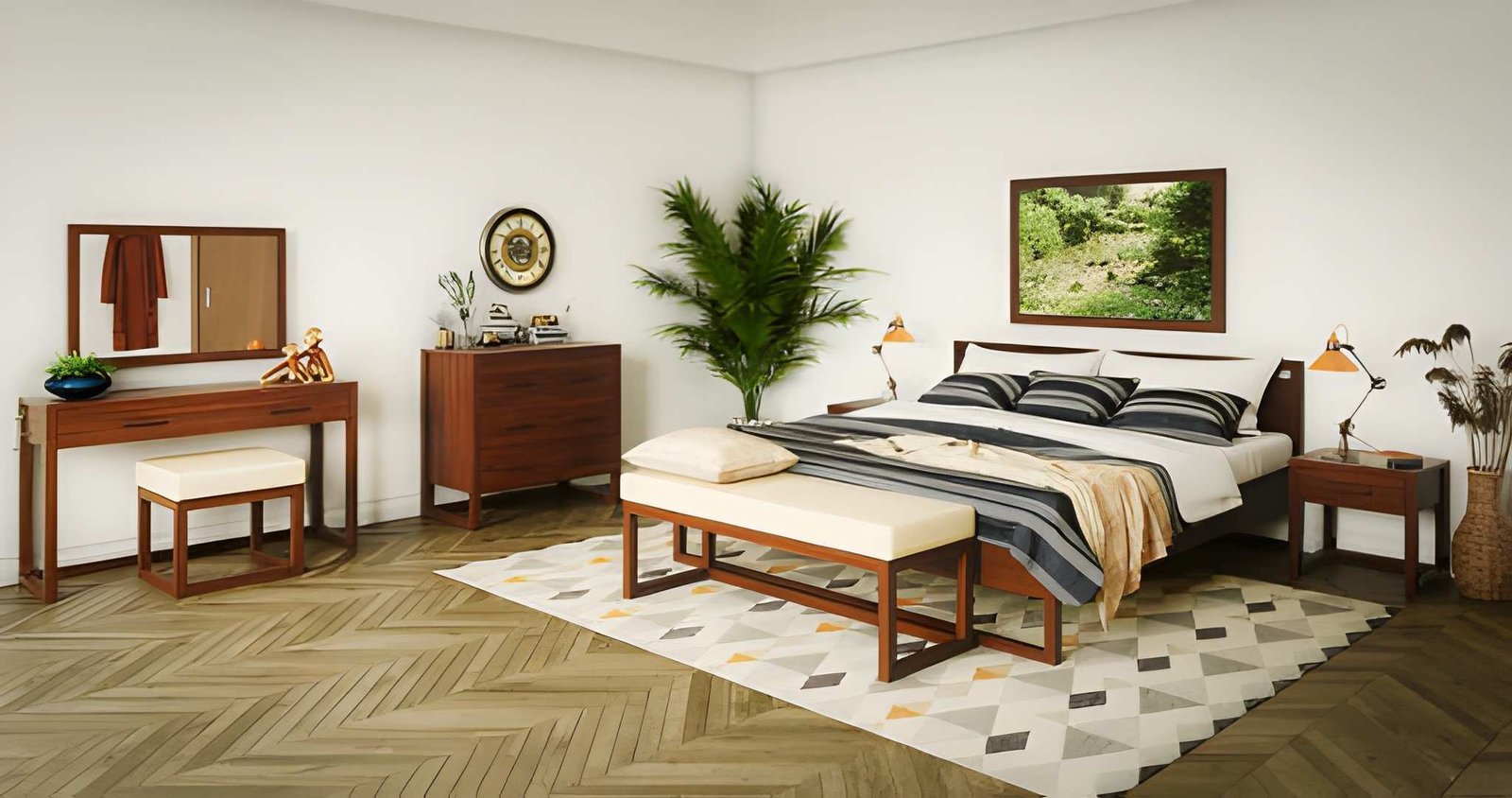
In Karachi, the bedroom has quietly become the room where households think hardest before they spend. It is used every day, it is shared with no guests, and it sits at the center of life’s biggest moments, from weddings to first apartments to growing families. As housing shifts toward compact apartments and as buyers grow more informed, Bedroom Furniture in Karachi is moving from a routine purchase to a carefully researched investment. The market that serves it is responding, with more choice, more scrutiny, and rising expectations on quality. A Room Doing More Than Ever Hybrid work, longer hours at home, and a growing cultural focus on rest and wellbeing have changed what a bedroom is for. For many Karachi households it is now a retreat, a dressing room, and sometimes a workspace. That broader role shapes what people buy: better bed frames, supportive headboards, coordinated storage, and calmer design, with muted palettes and textured upholstery replacing heavy ornamentation. The Core Pieces and What to Know About Each Beds. The bed anchors the room and the budget. Buyers choose among standard frames, upholstered beds, and storage or platform designs. Key points to check are frame construction, slat or base support, headboard height, and whether the design suits the room’s proportions. Wardrobes. Often the largest item, wardrobes are where space planning matters most. Sliding-door units save swing clearance in compact rooms, while hinged designs suit larger spaces. Interior layout, hinge quality, and board stability deserve as much attention as the exterior finish. Dressing units and side tables. These finishing pieces determine whether a room feels coordinated. Slim, floating, or compact designs help in smaller bedrooms. Complete sets. Coordinated collections ensure matching proportions and finishes, which is why many families, especially wedding buyers, prefer them to assembling pieces separately. Designing for Karachi’s Climate Humidity, heat, and coastal salt air are the unseen specification behind every bedroom piece sold in the city. Poorly seasoned timber warps, low-grade boards swell, unsealed edges peel, and inexpensive hinges and runners corrode. Air-conditioned showrooms hide these problems, which typically emerge within a monsoon season or two. Makers who build well for Karachi usually rely on: Seasoned wood or moisture-resistant engineered boards for stable frames and panels. Sealed edges that block humidity and prevent peeling. Durable finishes that resist scratches, stains, and moisture. Corrosion-resistant hardware that keeps doors and drawers working smoothly. Space Shapes Design Apartment living has pushed demand toward space-conscious pieces: storage beds with drawers or lift-up bases, slim or sliding-door wardrobes, compact dressing units, and lighter bedside tables. Larger homes in established neighborhoods continue to support substantial bedsteads, tall upholstered headboards, and complete coordinated sets. The market is diversifying rather than moving in a single direction, and the strongest brands serve both ends. Wedding Season and Lasting Value Bridal bedroom sets remain among the most significant furniture purchases a family makes. They are emotionally meaningful, financially substantial, and expected to last for decades. Demand peaks during wedding seasons, which stretches workshop capacity and delivery schedules. Buyers planning around a date should order early, confirm timelines in writing, and allow a buffer for delays. This is where a specialist offers an advantage. JF Homes, a Karachi-based bedroom furniture brand, focuses on this room alone, which allows closer attention to proportion, finish, and storage than a general furniture store can usually give. The Informed Buyer Social media and online catalogs have made Karachi’s bedroom furniture shoppers better informed and more demanding. Instead of asking only about price, buyers now ask: What is the frame made of, and how are the joints built? Which finish and hardware are used? What warranty and repair support is included? Are delivery and installation part of the price? Retailers who answer plainly earn trust quickly in a market where reputation travels through families and friends. Vague claims of “premium quality” increasingly work against a seller. Price and Value Costs for timber, boards, fabrics, imported fittings, and transport have pushed prices upward, and buyers are right to be cautious. The cheapest set is rarely the least expensive over time. A bed that warps or loosens within two seasons costs more than a well-built one bought once. Comparing cost per year of use, along with warranty coverage and the ability to repair, refinish, or reupholster later, gives a truer picture of value. A Buyer’s Checklist Measure first, including doorways, lifts, and stairwells, so delivery goes smoothly. Inspect construction: joints, drawer runners, hinges, and the backs of wardrobes. Request material details in writing, including board or wood type and hardware. View fabric and finish samples in your own home’s lighting. Confirm warranty, delivery, and installation terms before paying. Outlook to the End of 2027 Through the end of 2027, several trends are likely to shape Karachi’s bedroom furniture market. Compact and modular designs will keep gaining share as housing becomes denser. Warm, textured, understated styling will continue to replace high-gloss ornamentation. Customization of sizes, fabrics, and finishes will move from premium extra to normal expectation. Local manufacturing will strengthen as buyers weigh import costs and delays. Online discovery will keep growing, though most buyers will still want to inspect quality in person. And durability and after-sales service will weigh more heavily in every decision. For Karachi’s households, the outlook is encouraging: clearer information, wider choice, and stronger local workmanship. For JF Homes and its peers, the task through the end of 2027 is to build bedrooms that fit the space, survive the climate, and earn trust one household at a time. Frequently Asked Questions How do I choose bedroom furniture for a small room in Karachi? Measure the room first, then favor storage beds, sliding-door wardrobes, and slim dressing units. Light finishes and low-profile designs help compact bedrooms feel more open. What bedroom furniture materials work best in Karachi’s climate? Moisture-resistant engineered boards, well-seasoned solid wood, sealed laminates or veneers, and corrosion-resistant hardware perform best in humid, coastal conditions. Poorly treated timber and cheap fittings are most likely to warp or rust. Why is

Security and Surveillance Systems in Dubai: What a Modern, Layered Deployment Looks Like
Dubai’s growth has made security a design requirement rather than an afterthought. Towers in Business Bay, villas in Dubai Hills and Jumeirah, logistics yards in Jebel Ali, and retail frontages along Sheikh Zayed Road all depend on systems that watch, verify, and alert. Yet the phrase “Security and Surveillance Systems in Dubai” covers everything from a four-camera kit to a campus-wide platform with hundreds of endpoints. The difference in outcome lies less in the equipment list than in how the system is conceived, engineered, and maintained. Beyond Cameras: The Layers of a Modern System Surveillance is the monitoring and recording component. Security is the broader goal of deterring, detecting, and responding to threats. A well-planned system in Dubai usually combines several layers: Video surveillance: IP cameras, network video recorders, and video management software. Access control: Cards, PINs, biometrics, or mobile credentials that govern who can enter which areas. Intrusion detection: Door and window contacts, motion detectors, glass-break sensors, and perimeter beams. Video intercom: Visual verification of visitors at gates and entrances. Alarms and alerts: Local sirens, mobile notifications, and, where appropriate, monitored response. Automation links: Lighting, locks, and shutters that react to security events. Each layer works alone, but together they reduce blind spots and false alarms, because one system can confirm what another detects. Engineering for Dubai’s Conditions Climate is the first test of any specification. Summer heat, coastal humidity, and fine desert dust degrade weak equipment quickly. Outdoor devices should carry suitable ingress protection (IP66 or higher is common), tolerate high operating temperatures, and use corrosion-resistant fixings. Outdoor cabling belongs in conduit, exposed connections need sealed junction boxes, and equipment racks in utility rooms require ventilation. A single unsealed connector can cause intermittent faults months after handover. Scale is the second test. A villa may need eight cameras and a handful of sensors. A mixed-use development may need hundreds of devices, redundant servers, and centralised management across buildings. Good design begins with a site survey and risk assessment, assigning each camera a specific task, such as general awareness, facial identification, or number plate recognition, because each requires different optics and resolution. The Network is the Backbone Nearly all modern systems run on IP networking, so network engineering largely decides reliability. PoE capacity: Switches must supply enough power for cameras, infrared illuminators, and PTZ motors, with headroom for expansion. Bandwidth and storage throughput: High-resolution streams consume significant capacity. Uplinks and recorders must be sized accordingly. Segmentation: Placing security devices on a dedicated VLAN limits congestion and contains risk if another device is compromised. Power resilience: Uninterruptible power supplies keep recorders, switches, and critical devices running through short outages. Storage is a calculation, not a guess. Required capacity depends on camera count, resolution, frame rate, compression codec, and retention days. H.265 can substantially reduce storage compared with older codecs, though savings vary with scene activity. Surveillance-grade drives, built for continuous writing, are worth the added cost. Cybersecurity: Protecting the Protectors Connected security devices are targets in their own right. Default passwords, outdated firmware, and open remote-access ports remain well-known weaknesses. A professional installation replaces default credentials, applies current firmware, disables unused services, and provides remote access through a VPN or secure relay rather than open port forwarding. Multi-factor authentication should be enabled wherever it is supported. Recording these steps at handover gives owners a clear baseline for future audits. Regulation and Privacy Security systems in Dubai operate within a regulatory framework. The Security Industry Regulatory Agency (SIRA) regulates security systems and service providers across much of the emirate, and many commercial and public-facing premises must meet its requirements on equipment, installation, and recording. Federal data protection law also shapes how footage of identifiable individuals is stored, accessed, and shared. In practice, cameras should not look into neighbouring private spaces, businesses should consider signage and retention policies, and installations should be carried out by authorised providers. Requirements differ by property type and are updated over time, so owners should confirm current obligations with their provider and the relevant authority before work begins. Analytics and Integration Video analytics have become a mainstream expectation. Line crossing, intrusion zones, people and vehicle classification, and automatic number plate recognition help operators focus on genuine events instead of hours of uneventful footage. Properly tuned, they also cut false alarms. Integration is where security becomes active. With Smart Living Technology, camera events can be linked to lighting, locks, and notifications, and a gate camera can appear on a video intercom screen. Combining surveillance with home and building automation turns a passive record into a coordinated response. Choosing the Right Provider Authorisation: Confirm the company is approved for your property type and emirate. Process: Look for a documented survey and design stage, not a quote based on a phone call. Written scope: It should list camera models, cabling, storage capacity, and retention days. Support terms: Check warranty length, response times, and maintenance options. Ownership: You should hold administrator credentials and receive full handover documentation. Specification over price: The cheapest quote often omits conduit, adequate storage, or commissioning. Warning signs include skipped site visits, vague answers on remote-access security, and reluctance to discuss compliance. Conclusion A security and surveillance system in Dubai should be judged by how well it detects, verifies, and supports a response, not by camera count. The strongest deployments combine careful design, climate-appropriate equipment, a hardened network, regulatory awareness, and dependable aftercare. As analytics, cloud management, and automation mature, systems built to scale will stay relevant well beyond the end of 2027. For homes and businesses seeking that standard, Smart Living Technology delivers integrated security, surveillance, and automation solutions designed for the demands of Dubai. FAQs How do I know which security and surveillance system suits my property? Begin with a site survey and risk assessment. The right design depends on property size, entry points, lighting, occupancy patterns, and what you need to detect or identify. A professional provider translates those needs into a specified design with a written scope. What is included in a

Affordable Hydrafacial in Johar Town: Separating Real Value from a Low Price Tag
Few aesthetic treatments have spread as quickly as the Hydrafacial. It offers a short session, no recovery period, and skin that looks cleaner and more hydrated the same day. For many people in Lahore, it is an entry point into professional skin care. In Johar Town, where clinics compete for the same clients, prices vary widely, and the word “Affordable Hydrafacial in Johar Town” is used loosely. What the treatment actually involves, what it can and cannot do, what drives its cost, how to judge a clinic, and how to build a routine that fits a budget through the end of 2027. What the Treatment Is HydraFacial is a branded system built around a device that delivers several steps in one session using single-use tips and proprietary serums. Many clinics also offer hydradermabrasion or “hydra facials” using other machines. These can be sound treatments, but they are not automatically the same product, so asking which device a clinic uses is a fair first question. A session usually follows a set order: Cleansing and exfoliation to remove dead surface cells A mild chemical peel, often glycolic or salicylic acid, to loosen debris Extraction using gentle suction to clear congested pores Hydration and infusion of serums such as hyaluronic acid or antioxidants Optional boosters, for example for dullness, pigmentation or acne-prone skin, and add-ons such as LED light Sessions typically take 30 to 60 minutes. Most people resume normal activities immediately, with mild redness that fades within hours. What It Can Do, and What It Cannot Hydrafacial is a refresh and maintenance treatment. It suits dullness, congested pores, rough texture, and dehydrated skin. Many people book it before events because the skin looks clear and hydrated without peeling. It is not a medical treatment for deeper concerns. It will not meaningfully change deep acne scars, established melasma, sagging skin or deep wrinkles. Those call for other approaches, chosen after assessment, such as medical-grade peels, microneedling, lasers or prescription products. A trustworthy practitioner tells you when Hydrafacial is not the right tool, rather than selling a package for a problem it will not solve. Results are real but modest and temporary. Skin generally looks better for days to a few weeks, and benefits build with regular sessions plus a sensible home routine. Who Should Take Care Hydrafacial is gentle, but not every skin suits it at every moment. Speak to a professional first if you have: Active skin infection, open wounds, or cold sores in the area Severe, inflamed acne Rosacea or an eczema flare Recent sunburn, laser treatment, or peel Use of isotretinoin or other strong prescription skin medication Pregnancy, since some acids and serums may not be recommended Be open about what you use at home, including retinoids and exfoliating acids, as combining them with treatment can irritate the skin. Patients with medium to deeper skin tones, common in Pakistan, should mention any tendency to develop dark marks after irritation. Hydrafacial carries a low risk of this, but an assessment still helps. How Pricing Works Understanding what stands behind a price makes comparison easier. Device and consumables. Genuine branded systems rely on single-use tips and proprietary serums that cost the clinic more per session. Cheaper machines and generic solutions cost less to run. Practitioner training. A trained aesthetic professional working under proper supervision takes time and charges accordingly. Session length and extras. A longer session with boosters naturally costs more than a basic one. Package structure. Bundles often reduce the per-session price but require payment up front. Check expiry dates and refund terms. Standards and overheads. Hygiene, equipment, and staffing all add cost. Affordable should mean a fair price for a safe, properly delivered treatment. A price far below the local range may signal diluted products, reused or generic consumables, or a rushed procedure. Ask what is included, and whether tips and serums are single-use for every client. A Checklist for Choosing a Clinic A short call or consultation can reveal a lot. Assessment first. A good provider asks about your skin type, concerns, medications and history before recommending treatment. Honest expectations. They explain what the treatment can and cannot do and how many sessions are realistic. Hygiene. Single-use tips, clean surfaces and fresh gloves are basic. Ask how equipment is cleaned between clients. Qualified staff. Ask who performs the treatment and what their training is. Doctors and dentists register with the Pakistan Medical and Dental Council, so you can ask about supervision and credentials. Written pricing. The quote should show the session price, add-ons and package terms. No pressure. Be wary of heavy upselling or “today only” offers. Where Elora Dental and Aesthetics Fits Elora Dental and Aesthetics operates in Johar Town and offers dental and aesthetic care in one setting. For patients, this can be convenient, since skin treatments and dental visits can be managed together. As with any clinic, verify the details yourself: ask which system is used, who performs the treatment, what the session includes, and how it is priced, and compare that with other options. Treat claims, including those in articles like this one, as points to confirm in person. Getting the Most from Each Session Start small. Book a consultation and a single session to see how your skin responds before paying for a package. Pick a sensible rhythm. Many practitioners suggest sessions every few weeks to monthly, adjusted to your skin and goals. More frequent treatment does not necessarily improve results and can irritate sensitive skin. Match treatment to the problem. If pigmentation, scarring, or persistent acne is the main concern, ask whether a different treatment, or a combination, would serve you better. Protect the result. A gentle cleanser, a suitable moisturizer and a broad-spectrum sunscreen used daily matter more than any single serum. Lahore’s strong sun can undo a good facial quickly. Know when to call. Persistent redness, burning, swelling, or an unusual reaction deserves a call to the clinic. After treatment, avoid harsh scrubs and strong actives for a day or