Introduction
Every house has a different plot and a different entrance. A gate that looks perfect on a friend’s house can fail on yours because the width is wrong or the road is too narrow for the panels to swing. That is why main gate design should begin with your own plot and not with a photo from the internet. A good house main gate keeps the property safe and gives the home a clear first impression from the street. This guide explains how to plan home gate design step by step. It covers measurements, style, finish and the common mistakes that owners make. It also explains what suits gate design in Pakistan where sun and rain test every fitting.
Start With Your Plot and Entrance
Walk to the spot where the gate will stand and look at the space around it. Check how wide the opening is and how close the road runs to the wall. Notice whether the ground slopes, since a sloping entrance changes how a gate swings. Think about the cars you own and the largest vehicle that may enter, such as a delivery truck. Write these points down before you talk to any maker. A plan built on real measurements avoids the costly mistake of ordering a gate that does not fit the opening.
Common Mistakes in Main Gate Design
Many problems come from small choices made too quickly. Some owners pick a gate that is too narrow for a car to turn in easily. Others choose swinging panels without checking whether the road gives enough room. Heavy decoration is another trap because it looks rich at first but collects dust and rust in the curves. Some owners skip a proper hinge post and the gate sags within a year. Spending an hour on these points before you decide saves far more time and money later.
Getting the Height and Width Right
A main gate should look balanced against the boundary wall. A common height is between six and eight feet, depending on the wall around it. A gate that stands much lower than the wall looks weak and offers little privacy. One that towers above it looks heavy. For width, a single car needs about ten feet, while two cars side by side need closer to sixteen. Leave a small side entry for people on foot so the large panels stay closed most of the day.
Home Gate Design Styles
Modern Gate Style
Modern home gate use flat panels and straight bars with very little decoration. A matte black or dark grey finish gives a sharp look and hides dust. This style suits houses with plain fronts and clean lines. Because the pattern is simple the gate costs less to build and repaint. Many owners add a solid lower section for privacy and open bars above so light still passes through. The result feels calm and fits well with newer housing schemes.
Classic Gate Style
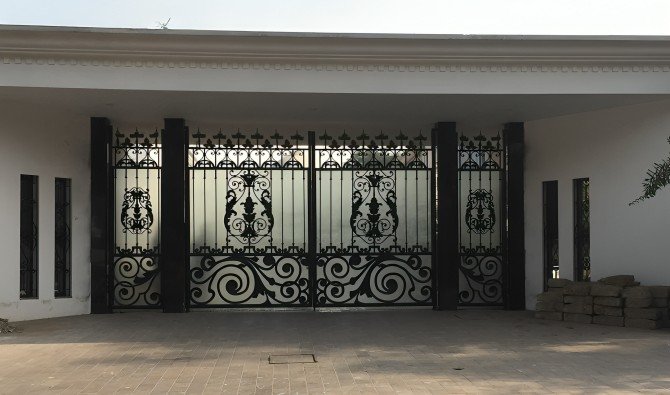
Classic gates bring curved bars, scrollwork and raised patterns. They suit houses with arches or carved trims where a plain gate would look thin. A single decorated panel at the centre can give a rich look without crowding the whole gate. Keep the pattern open so dust does not settle in tight curves. The level of detail should match the house. A busy gate on a plain house feels out of place, while a simple gate on a carved house looks unfinished.
Colour and Finish
Colour changes how large or small a gate feels. Dark tones such as black and deep green give a strong frame against light walls. Lighter shades soften a bold front and stay cooler in summer. The finish matters as much as the colour. A good primer and a hard top coat protect the metal from moisture and stop fading under strong sun. Ask how many coats are applied and whether the gate is painted before or after fitting. A well-finished gate looks fresh for years.
Weather and Gate Design in Pakistan
Gate design in Pakistan has to cope with heat and heavy rain and dust. Metal expands in summer and contracts in cooler months, so joints must be built to allow for this. Rain finds weak spots and starts rust at the bottom edge first. Raise the gate slightly above the ground so water does not pool around it. In dusty areas, choose smooth hinges that can be wiped clean. These small choices decide whether a gate runs smoothly or sticks within a few seasons.
Fixing and Installation
A strong gate needs strong support. Hinge posts should be set deep into concrete so they carry the weight without leaning. Check that the gate swings freely and closes with a firm latch. A gap that is too wide at the bottom lets animals through while a gap that is too narrow makes the gate scrape. Ask the maker to test the gate on site before the work is signed off. Good fixing matters as much as good design.
How Red Line Collection Makes Every Gate
Red Line Collection is a home interior design brand based in Lahore that makes pieces to order for the space they will sit in. Each gate starts with exact measurements of your entrance and a talk about the style you like. The team works with iron, steel, wood, brass and glass and puts effort into skilled craftsmanship and careful finishing. Every gate is checked for firm fitting and an even coat before it leaves the workshop. Orders reach homes across Pakistan so owners in any city can get a gate made for their own plot.
Conclusion
Planning a gate gets easier when you work in order. Measure your plot and the entrance first. Decide the height and width that suit your wall and your vehicles. Choose a style that matches the house and a finish that handles your weather. Make sure the hinge posts are strong and the fixing is tested. A main gate planned with this care keeps your home safe and looking right for many years.